

How to Brew Better Coffee at Home: 2026 Guide
Table of Contents
- Start With Fresh Beans: Why Roast Date Beats Everything
- Coffee Brewing Ratios: The Golden Rule for Balanced Flavor
- Coffee Grind Size Guide: Match Your Grind to Your Brew Method
- Best Water Temperature for Coffee: Why 195-205°F Matters
- How to Store Coffee Beans for Freshness: Science-Backed Tips
- Troubleshoot by Taste: Fix Sour, Bitter, or Weak Coffee
- Step-by-Step: How to Brew Better Coffee at Home Today
- Conclusion: Your Next Cup Starts Here
- Frequently Asked Questions
Last Updated: October 4, 2026
Start With Fresh Beans: Why Roast Date Beats Everything
To brew better coffee at home, start before your kettle hits the stove. Freshness is the biggest variable most home brewers ignore, it matters more than your grinder, pour technique, or the price of the bag.
Coffee is perishable: once roasted, beans degas and oxidize as they meet air.
Here is the practical rule we give every customer:
- Days 1-3 after roast: too fresh for most methods; degassing interferes with even extraction
- Days 4-14: the sweet spot for filter and pour-over brewing
- Days 15-30: still good, but flavor flattens noticeably
The Specialty Coffee Association's freshness guidance notes that roasted coffee quality declines measurably within weeks, not months. That is why we print roast dates, not vague "best by" stamps.
Coffee Brewing Ratios: The Golden Rule for Balanced Flavor
The golden ratio for coffee brewing is 1:15 to 1:18, meaning one part coffee to fifteen to eighteen parts water by weight.
Weight, not volume, matters: a "scoop" varies with grind size, bean density, and how you heap it, while a digital scale removes that guesswork in seconds.
| Brew Method | Coffee-to-Water Ratio | Why It Works |
|---|---|---|
| Pour-over | 1:15 | Fuller body, brighter acidity |
| Drip machine | 1:16 | Balanced everyday cup |
| French press | 1:15 | Richer mouthfeel, immersion brewing |
| Cold brew | 1:8 concentrate | Dilute to taste before serving |
| AeroPress | 1:13 | Strong, concentrated base |
Start at 1:16, then adjust. If the cup tastes thin and sour, add coffee. If it tastes heavy and bitter, add water or coarsen the grind.

Coffee Grind Size Guide: Match Your Grind to Your Brew Method
Grind size is the most powerful adjustment you control: it determines how much surface area the water reaches and how fast flavor compounds dissolve.
Coffee contains hundreds of soluble compounds that dissolve at different rates: fruit acids and sugars first, then caramelized sweetness, then bitter, dry, woody compounds.
That is why the same beans can taste sour one morning and bitter the next with nothing changed but the grind.
Grind size by brew method
- Cold brew: extra coarse, like raw sugar or peppercorns. Long immersion needs slow extraction.
- French press: coarse, like sea salt. The metal mesh lets fines through, so err coarser than you think.
- Drip machine: medium, like table salt. Basket geometry and flow rate vary, so treat this as a starting point.
Why burr beats blade, and what particle distribution actually means
A blade grinder chops beans into a random mix of dust and boulders. The dust over-extracts into bitterness while the boulders under-extract into sourness, in the same cup. No adjustment fixes it, because the problem is the spread, not the average.
A burr grinder crushes beans between two hardened surfaces set a fixed distance apart, producing a narrow particle-size distribution, consistency that lets you taste the effect of a single change.
How to dial in your grind (the adjustment loop)
Treat grind like a dial, not a setting. Change one notch, brew, taste, repeat.
- Start at the recommended setting for your method.
- Brew a full cup using your normal ratio and temperature.
- Taste for the tell. Sour, thin, or salty means under-extracted, go one step finer. Bitter, dry, or chalky means over-extracted, go one step coarser.
- Change only the grind. If you also change dose or temperature, you will not know which variable moved the cup.
- Repeat until the cup tastes balanced, sweet, with clear acidity and a clean finish.
Most practitioners find the sweet spot within two or three adjustments. Keep notes for the first week; after that, your grinder's numbers become muscle memory.
Best Water Temperature for Coffee: Why 195-205°F Matters
The best water temperature for coffee is 195-205°F (91-96°C). Below that range, water under-extracts and tastes sour; a rolling boil scalds the grounds and pulls out harsh, bitter compounds.
Most drip machines brew at temperatures that swing during the cycle, which is why the same beans taste inconsistent from one morning to the next.
Temperature stability matters as much as the target number.
How to Store Coffee Beans for Freshness: Science-Backed Tips
Storing coffee beans for freshness comes down to four enemies: oxygen, heat, light, and moisture. Defeat all four and your beans hold their flavor for weeks longer.
The biggest mistake we see is careless freezing.
Single Origin Favorites Sample Pack →
What actually works:
- Keep beans in an opaque, airtight container at room temperature
- Store away from the stove, oven, and windows
- Buy whole bean and grind immediately before brewing
Valve-sealed bags are fine for the first week. After that, move beans to a proper container. Coffee absorbs odors, so never store it beside spices or onions.
Troubleshoot by Taste: Fix Sour, Bitter, or Weak Coffee
Your palate is the best diagnostic tool you own. Instead of guessing, taste the cup and work backward to the variable that caused it, the fastest way to brew better coffee consistently.
The logic is simple once you know the mechanism. Coffee extracts in stages: acids and fruit first, then sugars and caramel sweetness, then bitter and dry compounds. A balanced cup lands right after the sweet stage.
The taste map
| Taste Problem | What It Means | Likely Cause | The Fix |
|---|---|---|---|
| Sour, sharp, salty | Under-extraction, brew stopped before sweetness arrived | Grind too coarse, water too cool, brew too short, or too little coffee | Grind finer, raise temp toward 200°F, extend contact time, or tighten ratio toward 1:15 |
| Bitter, dry, harsh | Over-extraction, brew ran past the sweet stage into bitter compounds | Grind too fine, water too hot, brew too long, or too much coffee | Grind coarser, lower temp toward 195°F, shorten contact time, or loosen ratio toward 1:17 |
| Weak, watery | Too little coffee for the water, or too coarse a grind | Ratio too loose, or grind too coarse for the method | Tighten ratio toward 1:15, then adjust grind |
| Flat, lifeless | Stale beans, or water that is too soft | Roast date past 30 days, or low-mineral water | Check roast date, buy fresher, or use filtered water with some mineral content |
| Inconsistent cup to cup | Uneven grind or channeling | Blade grinder, or pour technique that carves a channel through the bed | Upgrade to a burr grinder, pour in slow even circles, level the bed before brewing |
| Sour and bitter at the same time | Uneven extraction, some grounds over, some under | Blade grinder, or too fine a grind causing channeling | Switch to a burr grinder, coarsen slightly, improve pouring technique |
How to isolate the variable
Adjust one thing at a time. Change the grind, brew, taste, and note the difference. Changing three things at once tells you nothing about which one worked.
A practical order of operations:
- Fix the ratio first. If the cup is weak or overwhelming, dose is the problem. Get to 1:16 before touching anything else.
- Then fix the grind. Sour or bitter with the right ratio almost always means grind. Move one step and re-taste.
- Then adjust temperature. Only after ratio and grind are dialed in does temperature become the fine-tuning lever.
- Then look at technique. Channeling from a bad pour shows up as a cup that is sour and bitter at once, a sign the water found a path through the bed instead of saturating it evenly.
The two-cup test
When you are stuck, brew two cups back to back with one variable changed, say, one grind step finer, and taste them side by side. The difference is usually obvious, and it teaches your palate what each adjustment does. After a week, you will diagnose most cups in a single sip.
Step-by-Step: How to Brew Better Coffee at Home Today
Here is the full process, start to finish, using a pour-over as the example. Total time is about six minutes once your water heats.
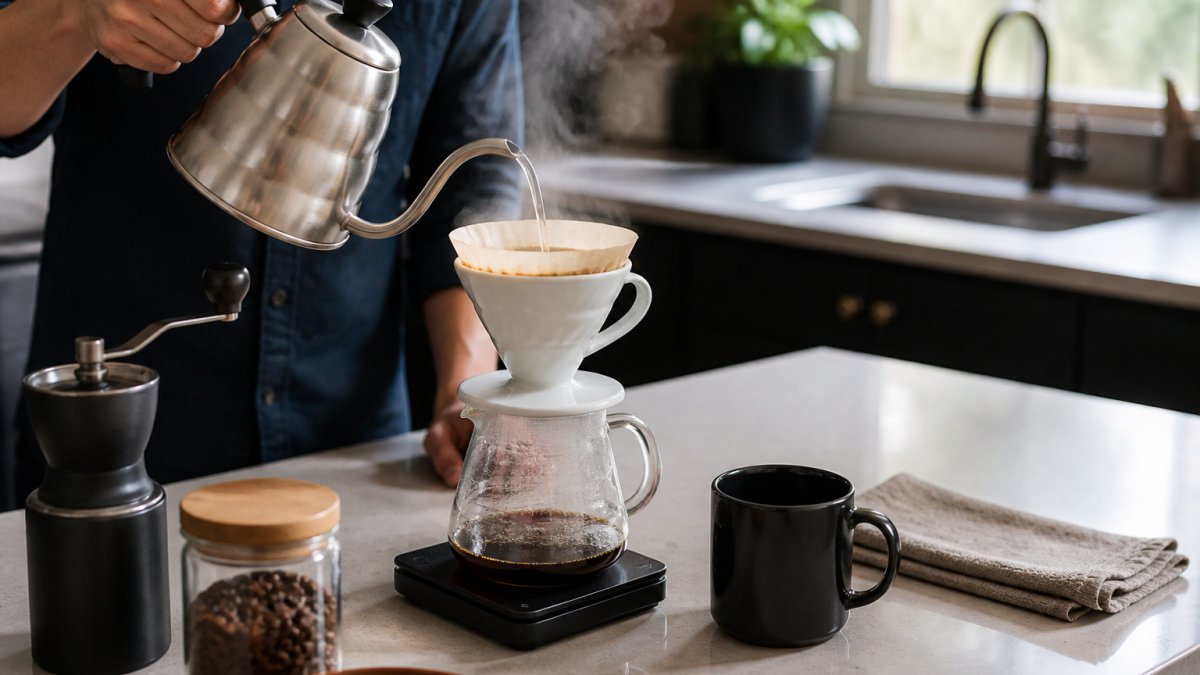
What you'll need: fresh whole-bean coffee, a burr grinder, a digital scale, filtered water, a gooseneck kettle, a paper or metal filter, and a mug.
- Weigh your beans. Use 20g of coffee for 320g of water at a 1:16 ratio. [Time: 1 minute]
- Heat filtered water to 200°F. [Time: 3-4 minutes]
- Grind medium-fine, just before brewing, and add grounds to a rinsed filter.
- Bloom the coffee. Pour 40-60g of water over the grounds and wait 30-45 seconds. This releases trapped CO2 so water can extract evenly.
- Pour in slow circles, working outward from the center, in two or three stages. Keep the slurry level steady.
- Finish the brew between 2:30 and 3:30 total contact time.
- Taste and adjust. Sour? Grind finer next time. Bitter? Go coarser.
Expected result: a balanced cup with clear acidity, sweetness, and a clean finish. If your first attempt misses, that is normal.
For cold brew, the method changes but the principle holds: use a coarse grind, a 1:8 concentrate ratio, and steep 12-18 hours in the fridge. Our Cold Brew Coffee is blended specifically for this, with chocolate and toffee tones that hold up over long immersion.
Conclusion: Your Next Cup Starts Here
Most people chase better coffee through equipment, when the real gains come from freshness, ratio, grind, and temperature. Get those four right and even a basic drip machine beats most cafés.
That is why we exist at Cassien Alan Coffee. To taste what fresh actually means, start with our Single Origin Favorites Sample Pack or the Best Sellers Sample Pack, both six 2oz packs for $24.99.


Get started with Cassien Alan Coffee and brew a cup that tastes like it was roasted for you, because it was.
Frequently Asked Questions
What is the most effective way to brew better coffee at home?
Start with freshly roasted beans and a burr grinder for consistent grind size. Use a digital scale to measure a 1:15 to 1:17 coffee-to-water ratio, heat water to 195-205°F, and match your grind to your brew method. Pre-heat your equipment, use filtered water, and adjust one variable at a time. These steps give you control over extraction, which is what separates a good cup from a great one.
What is the 15-15-15 coffee rule?
The 15-15-15 rule is a simple brewing guideline: use a 1:15 coffee-to-water ratio (1 gram of coffee to 15 grams of water), aim for a 15-minute total brew time for cold brew, or 1.5 to 4 minutes for hot methods depending on the brewer. Some interpret it as 15 grams of coffee, 15 ounces of water, and 15 minutes for immersion brewing. It is a starting point, not a strict law.
Does water temperature really change the taste of coffee?
Yes. Water that is too cool (below 195°F) under-extracts, leaving coffee sour and weak. Water that is too hot (above 205°F) over-extracts, causing bitterness and a harsh mouthfeel. The sweet spot is 195-205°F, which dissolves the right balance of acids, sugars, and aromatics. A simple kitchen thermometer or a kettle with temperature control helps you hit that range consistently.
How does grind size affect the flavor of my coffee?
Grind size controls how fast water extracts flavor. Too coarse and water passes through quickly, leaving coffee weak and sour. Too fine and water stalls, pulling out bitter compounds. Match grind to brew method: coarse for French press and cold brew, medium for drip and pour-over, fine for espresso and AeroPress. A burr grinder gives you consistent particles, which leads to even extraction.
How fresh is 'fresh' coffee, and how should I store it?
Coffee is best within 2-4 weeks of its roast date. After that, flavors fade and stale notes develop. Store beans in an airtight, opaque container at room temperature, away from light, heat, and moisture. Do not refrigerate or freeze unless you seal them in a vacuum bag for long-term storage. Buy in small batches and grind right before brewing to preserve aroma and natural character.
Do I need an expensive setup to brew better coffee at home?
No. A burr grinder, a digital scale, a thermometer, and a simple pour-over or drip brewer cover the essentials. You can upgrade later. The biggest gains come from fresh beans, correct ratios, and consistent grind size, not from costly machines. Start with what you have, fix one variable at a time, and taste the difference.